
What Edu is reading this week (Jun 28 - Jul 4, 2026)
A week centred on running LLMs locally, new model releases from Anthropic and the government vetting of others, a big Immich release and self-hosting tooling, a couple of unsettling disk-encryption and firmware stories, and reviving old hardware.
AI, Models & Coding
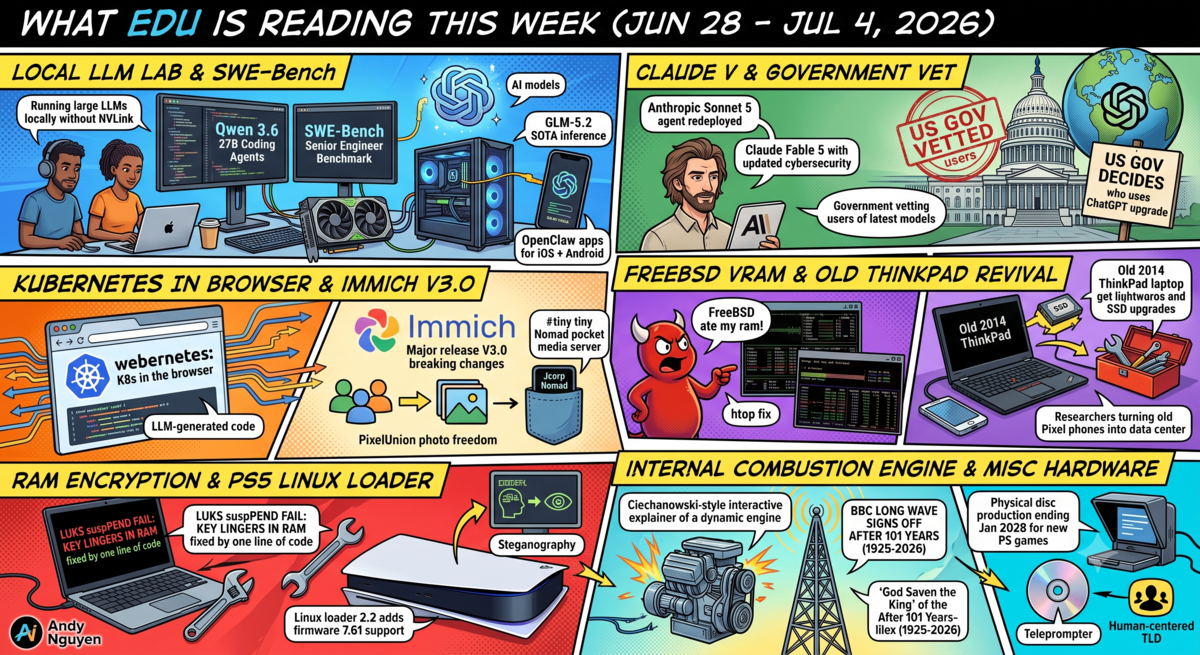
- local-inference-lab/rtx6kpro / jamesob/local-llm: A wiki on running large LLMs (Qwen3.5-397B, Kimi-K2.5, GLM-5) on PCIe GPUs without NVLink, plus a companion “everything I know about running LLMs locally” collection.
- Qwen 3.6 27B is the sweet spot for local development: Why Qwen 3.6 27B is finally a model good enough for coding locally on a MacBook or an RTX, using llama.cpp and OpenCode.
- Self-Host GLM 5.2: Open Weights & vLLM Guide: A planning guide for self-hosting GLM 5.2 — VRAM budget formula, ~744 GB FP8 weights, KV cache for 1M context, and vLLM vs SGLang.
- llm-d — SOTA LLM inference on any accelerator: An open-source inference serving stack for Kubernetes that runs vLLM, SGLang and more across a cluster on NVIDIA, AMD and custom accelerators.
- Introducing Claude Sonnet 5 / Redeploying Claude Fable 5: Anthropic’s most agentic Sonnet yet, and the redeployment of Fable 5 from July 1 after export controls were lifted, with updated cybersecurity safeguards.
- Senior SWE-Bench: A benchmark from Snorkel that evaluates agents as senior engineers on the kind of work actually handed to them.
- headroomlabs-ai/headroom: Compress tool outputs, logs, files and RAG chunks before they reach the LLM — 60-95% fewer tokens for the same answers, as a library, proxy or MCP server.
- OpenClaw is now on iOS + Android: Native mobile apps for OpenClaw, with channels, tasks and replies so you can run agents from your phone.
- Built-in Co-Authored-By: Claude commit trailer: An issue arguing that Claude Code’s default commit trailer asserts AI co-authorship, contrary to U.S. Copyright Office guidance.
- U.S. government will decide who gets to use the latest ChatGPT upgrade: OpenAI says the government will vet users of its newest model, as the administration increases oversight of the industry.
Cloud, Containers & Kubernetes
- ngrok/webernetes / I ported Kubernetes to the browser: Kubernetes running in the browser — almost 100,000 lines of LLM-generated code in two months, with the story of how it was built.
- Podman 6 Configuration File Changes: Ahead of the Podman 6 release, a rundown of the biggest change: a major rework of how configuration files are handled and parsed.
- Red Hat Enterprise Linux runner images in public preview: GitHub-hosted larger runners now support RHEL 9 and RHEL 10 images, in partnership with Red Hat.
Self-Hosting & Homelab
- Immich v3.0.0: The next major version of Immich after months of work, with breaking changes worth reading before you upgrade.
- romainrbr/immich-face-to-album / TrooP81/Immich-ppl2album: Two small tools to sync Immich faces into specific albums automatically.
- PixelUnion — Free your photos from American tech platforms / Immich FAQ: A managed Immich hosting service pitched on privacy, plus its FAQ on Immich features and compatibility.
- I Don’t Maintain My Homelab: An argument for a homelab that maintains itself rather than demanding constant attention.
- Jcorp Nomad: a self-hosted media server that fits in your pocket: A pocket-sized self-hosted media server project, well received on r/selfhosted.
- jomjol/AI-on-the-edge-device: An easy-to-use device for connecting “old” analog meters (water, power, gas) to the digital world.
Linux & Systems
- FreeBSD ate my ram!: A month spent researching FreeBSD’s virtual memory system to understand why htop, btop and fastfetch disagree about RAM usage — ending in patches to all three.
- NUMA Explained: Why Memory Distance Slows Your VMs: Why two identical VMs on the same host can perform 20% differently, and what NUMA topology actually costs you.
- Linux on Older Hardware: The Complete Revival Guide (2026): Lightweight distros, zram tuning, SSD upgrades and browser tweaks tested on a 2014 ThinkPad.
- Researchers turn old Pixel phones into a data center: Google Research reuses old Pixels — framed around “embodied carbon” — into a cluster that outperforms some server hardware.
Security
- A LUKS encryption key that lingered in RAM across suspend: A git-bisecting saga: since Linux 6.9 the tool locking a laptop’s LUKS drive on suspend was silently failing, leaving the key in memory — fixed with a single line.
- Claude Code Is Steganographically Marking Requests: An inspection of Claude Code that found hidden system-prompt markers derived from the API base URL and timezone.
- PS5 Linux loader 2.2: Andy Nguyen (“TheFlow”) announces version 2.2 of the PS5 Linux loader, adding support for PS5 firmware 7.61.
SDR, Hardware, Gaming & Misc
- Internal Combustion Engine — Bartosz Ciechanowski: Another of Ciechanowski’s beautiful interactive explainers, this time on how an internal combustion engine actually works.
- The BBC’s Long Wave signs off after 101 years: The BBC’s Long Wave broadcast went silent at 00:00 UTC — its last minute captured after the Shipping Forecast, with the notes of God Save the King and an automated end-of-transmission notice.
- Physical disc production ending in January 2028 for new PlayStation games: New PlayStation games will ship in digital-only formats, reflecting shifting consumer preferences.
- OpenRA: Classic real-time strategy games (Command & Conquer, Red Alert, Dune 2000) rebuilt for the modern era.
- Ferrari’s marketing boss quits weeks after EV launch backlash: The design of Ferrari’s first all-electric car, the Luce, was heavily criticised.
- rajtilakjee/kivo: A lightweight desktop teleprompter.
- HCCF’s vision for a human-centered top-level domain: The Human-Centered Computing Foundation makes the case for reclaiming our digital selves through a new human-centered TLD.